Motto:
Water from the crystal-clear well
…but you need not go for it into the depth of a forest.
Water filters
This term, inexact but understandable all over the world, denotes the utilities for additional treatment of water in places of final consumption. These utilities are involved in many kinds of human activities and employ considerable number of water- treating technologies – not only filtration. To be brief, let us turn our attention only to water filters used for acquiring high- quality drinking water for cooking and drinking in the households.
To acquire 1000 L of bottled water means to extract and put into bottles 1000 L of water, to deliver more than one ton of goods by both transport contractors and consumers and finally to dispose of 1000 packages made of durable materials including their liquidation.
To acquire 1000 L of filtered water means to produce and deliver a utility weighting approximately 0.08–1 kg (0.01 ton) that will be disposed of after about eight years.
These facts elucidate the incommensurability of ecological burden, high costs and technical complexity of non-water-plant ways of supplying high-quality drinking water for direct consumption. While the water-carrier was a biblical job, the designers of water filters found their job as late as in the 20th century. The development of water-plant technologies was accelerated by both the World Wars and, first of all, by the acknowledged effects of last decades' global ecological crisis upon the quality of drinking water.
Types of water filters
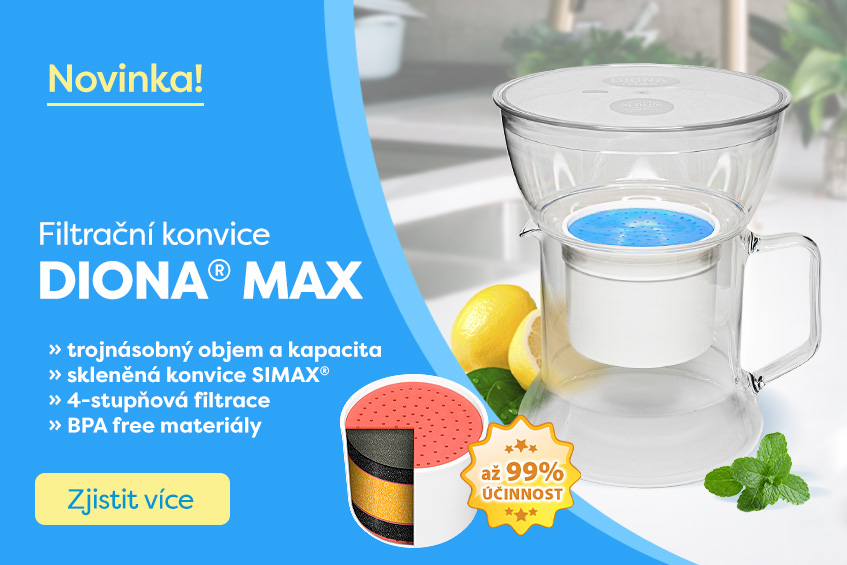
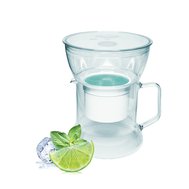
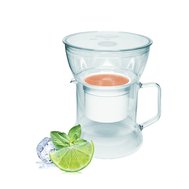
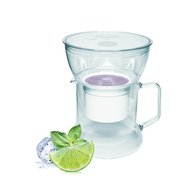
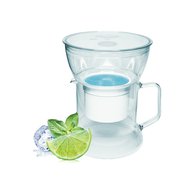
- Vessel filters. Amenities consisting of the upper and lower vessel with the usual capacities of 1–2 L. The filter with approximately 0.1 L of sorptive material is fixed bellow the upper vessel. Water poured into the upper vessel soaks through the filter into the lower vessel where it is collected. These filters do not need pressured water.
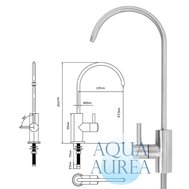
- Water filters of the third tap. Amenities with one or two elements placed on the desk – or under the desk – of the kitchen unit close to the sink. Cold water is supplied to the filter by a tap placed on the cold water pipe immediately before the mixing faucet or before the filter-sink switch placed usually at the end of the faucet's shoulder above the sink. Less frequently there is a separate third tap fixed on the kitchen unit desk. This tap is used when the filter is placed under the desk of a kitchen unit. Volumes of filtering materials in one filter are usually 0.3–0.7 L, exceptionally even more than 1 L.
- Faucet – also sink – filters represent a construction subgroup to the utility of the third tap. Small filtering body makes up one unit with the switch screwed on the end of faucet's shoulder above the sink. Volume of filtering matters – usually active coal – is approximately 0.1 L.
- Water filters fixed within the pipes are often used with exchangeable filtering cartridges for intercepting mechanical contaminants. They are delivered in containers and with filtering cartridges of various sizes, usually ranging from 5" up to 20" and more with a fitting of G3/4 and 1" and more.
- Filters on the inlet are the heaviest caliber among the technologies of water-treatment in the site of final consumption. They are usually multiple-element filter sets with the capacity of filtering materials counted in tens of liters, sometimes including regeneration of particular elements on the spot and automatic management of the work of the whole set.
Efficiency of water filters
The most important condition of water filters' high efficiency is their non-overburdening by excessive flow of water. Numerical value of the prescribed water flow in liters per minute should not be much higher than the volume of the bed fillings in liters. This condition is not met by faucet filters which are usually hydraulically overburdened by one order of magnitude.
Moreover, the filter should
- enable an easy estimation of the water flow,
- be of a thin and high shape.
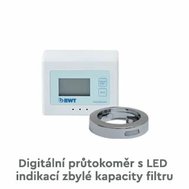
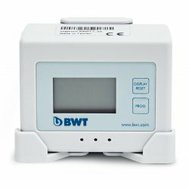
Efficiency of any filtering cartridge is not unlimited. The question "How shall I get to know that the cartridge is spent?" is thus pertinent. It is both possible and correct to equip the water filter eliminating (beside others) the nitrates with a control set for assessing the content of NO3- and the utility for dosing chlorine preparations by a set for assessing C12. But for each such aid the customer must pay. That is why it is sometimes sufficient – in case there is no health risk – to leave the decision upon the judgement of the user and instruct him/her, for instance, just to "exchange the cartridge of the mechanical filter when the flow becomes thinner".
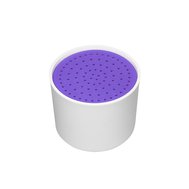
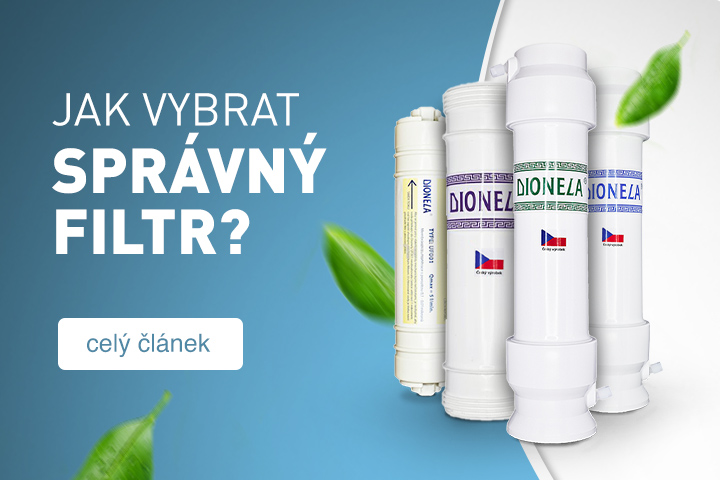
Filtering cartridges filled with active coal represent a special case. They eliminate a wide range of heavy metals, organic and specific organic substances, chlorine, etc. The idea of a customer executing control is completely illusory. For the laboratory assessment of only a few indicators he/she would often pay more than for the filter itself. Moreover, the bed of active coal doesn’t absorb all the contaminants within the same period of time. The only realistic solution is a large volume of sorptive material in the filtering cartridge and an exchange of the cartridge long before its capacity is exhausted. According to the water-plant criteria the capacity of Dionela’s filtering cartridge FAM 1, for instance, is 38 000 liters. Nevertheless, the producer recommends exchanging it after two years' operation. Within this period of time an average family of four will filter less than 6 000 liters of water that is less than 16% of its capacity. The rest, approximately 84 %, is a safety reserve ensuring that even in case of the highest concentrations of the most easily "transiting" contaminants (usually carcinogenic THMs) these substances will not find their way through the filter.
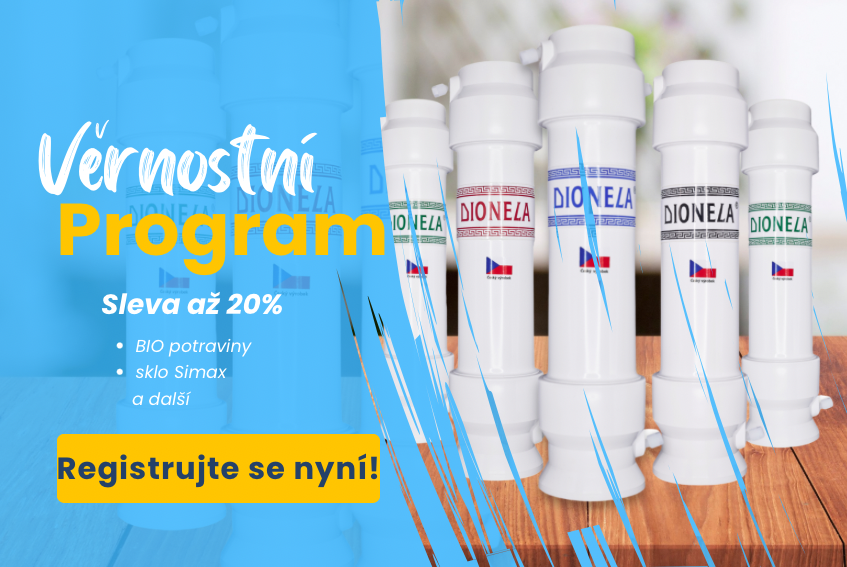
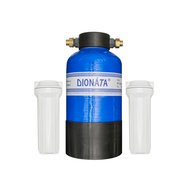
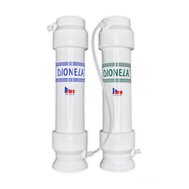
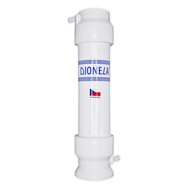
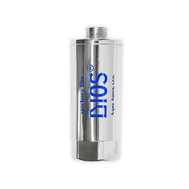
Water filters DIONELA and OASA were designed to meet exactly these criteria.
Cost of filtering by the Dionela filter
Cost of water filter Dionela’s operation:
The
calculation takes into account the eight-year service life of
DIONELA. After exhausting its capacity the cartridge is exchanged
for a regenerated one. The calculation was made for a family of
four meeting all their needs of drinking water by dioneled water.
That is – unlike purchasing the bottled water – financially
acceptable. Eight liters for a family per day, 365 days a year for
an eight year period of time… 23 360 liters of water. Compared to
the bottled water you’ll get, without causing any damage to the
environment and without complicated delivery, one liter of high-
quality drinking water even 50 times cheaper!
- The fixed costs per unit for the filtering cartridge FAM1 ensue from the fixed period of usage (2 years) and make up 0.01 €/l. Family costs per year: 0.01 × 8 × 365 = 29 €/year.
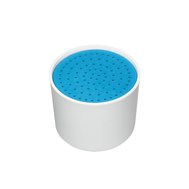
- FDN2 cartridge: in case of high inflow concentration of nitrates 100 mg/L NO3 – the concentration twice exceeding the norm limit and seven times higher than is the acceptable limit for sucklings: 0.06 €/L. Costs for a family of four: 175 €/year.
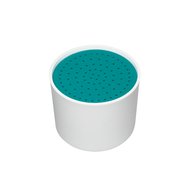
- Operating costs of the filtering cartridge FTK3 depend on its capacity which is, in case of an average transitory hardness, about 800 liters. The capacity depends not only on the transitory hardness of your water but also on other factors, in the first place on the flow of water. The costs are thus approximately 0.05 €/L.